

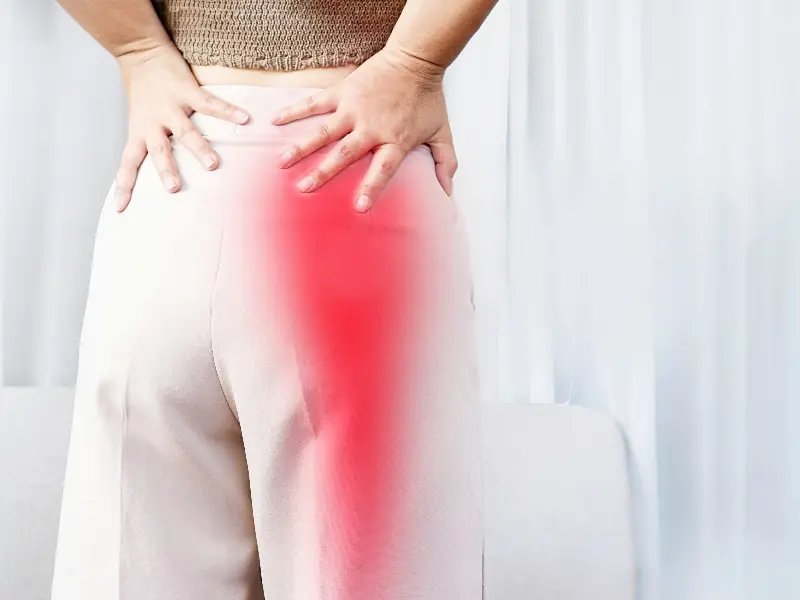
Sciatica isn’t actually a diagnosis – it’s a symptom. If you’re dealing with sharp, shooting pain down your leg, numbness in your foot, or a burning sensation that runs from your lower back through your buttock and down your thigh, that’s sciatica. The real question is what’s causing it – because treating the leg itself won’t fix anything if the problem is coming from your spine.
What Sciatica Actually Means
The sciatic nerve is the longest nerve in your body. It runs from your lower back, through your pelvis, down each leg, and all the way to your feet. When something irritates or compresses that nerve – usually in the lower spine – you feel it downstream in the leg.
That’s why sciatica can show up as pain behind your knee, tingling in your calf, numbness in your toes, or weakness when you try to stand on your tiptoes. The nerve is getting pinched at the source, but you feel the effects wherever that nerve travels.
Most people assume the problem is in their leg or hip because that’s where it hurts. They stretch their hamstrings, foam roll their IT band, or ice their glutes. And none of it helps, because the actual issue is four inches above their belt line.
The Most Common Causes of Sciatica

In the majority of cases, sciatica comes from a disc problem. Herniated discs and bulging discs are the usual suspects. When the soft inner material of a spinal disc pushes out and presses against the sciatic nerve root, you get all the classic symptoms – shooting pain, numbness, tingling, and sometimes muscle weakness.
Degenerative disc disease can also lead to sciatica, especially as the space between vertebrae narrows and puts pressure on nerve roots. Bone spurs, spinal stenosis, and spondylolisthesis can all compress the sciatic nerve as well.
Less commonly, the piriformis muscle in your buttock tightens up and squeezes the sciatic nerve as it passes underneath. That’s called piriformis syndrome, and it mimics sciatica even though the nerve compression is happening in the hip region rather than the spine.
At Indian Trail Chiropractic & Rehab, Dr. Gentile evaluates where the nerve irritation is actually coming from. Orthopedic tests, imaging review, and a detailed movement assessment pinpoint whether you’re dealing with a disc issue, a structural problem, or muscular compression. Treatment depends entirely on getting that part right.
Why Treating the Symptom Doesn’t Work
Most conventional treatment for sciatica focuses on managing pain rather than addressing the root cause. Anti-inflammatories, muscle relaxers, cortisone shots – those dull the pain temporarily, but they don’t fix the herniated disc or take pressure off the nerve.
Physical therapy can be part of the solution, but generic stretches and exercises won’t do much if there’s still a bulging disc compressing the nerve. You can strengthen your core and improve flexibility all you want – if the disc is still pushing on the nerve, the sciatica comes right back.
Surgery is sometimes presented as the only real solution, especially when symptoms have been going on for months. In severe cases involving significant nerve damage or loss of bowel and bladder control, surgery is the right call. But many patients are told they need surgery when the right conservative treatment could still resolve the problem – they just haven’t gotten there yet.
How Spinal Decompression Addresses the Root Cause
Spinal decompression is one of the most effective non-surgical treatments for sciatica caused by disc issues. It works by gently stretching the spine to create negative pressure inside the disc space, pulling bulging or herniated material away from the nerve.
Some patients feel relief quickly. Others notice gradual improvement over a few weeks as inflammation decreases and the nerve stops firing pain signals down the leg. The treatment also promotes nutrient flow into the disc, supporting actual healing rather than just symptom suppression.
Decompression targets the exact spinal segment where the nerve compression is happening. If your sciatica is coming from the L4-L5 or L5-S1 disc – the most common culprits – the table applies controlled traction to that specific area. Precise, measured force designed to relieve pressure on the sciatic nerve root, not a generic stretch.
We consistently combine decompression with chiropractic adjustments to restore proper alignment and movement in the lower back. When the vertebrae are moving correctly and disc pressure is reduced, the nerve has the space it needs to function without interference.
What About Sciatica That Isn’t From a Disc?
When sciatica is coming from piriformis syndrome or a structural issue like spinal stenosis, the treatment approach looks different. Soft tissue work – like Active Release Technique or Graston Technique – releases tight muscles that are compressing the nerve and produces strong results for that presentation.
For stenosis-related sciatica, decompression can still help by opening up space in the spinal canal, combined with corrective exercises to improve stability and reduce load on the lower back.
One-size-fits-all treatment doesn’t work for sciatica. Dr. Gentile’s background as a Certified Chiropractic Extremity Practitioner and his 20+ years treating complex spinal cases means every patient gets a treatment plan built around what’s actually driving their symptoms – not a guess.
How Long Does It Take to Get Relief?
That depends on how long you’ve had sciatica and how severe the nerve compression is. Acute sciatica – where symptoms started recently – responds faster. Chronic cases take longer, especially when the body has been compensating for months or years and those patterns need to be unwound.
The goal isn’t just getting you out of pain. It’s restoring normal function so the sciatica doesn’t return every time you bend over or sit in the car for more than 20 minutes. That means addressing the underlying disc problem, improving spinal stability, and retraining the movement patterns putting excessive stress on your lower back. The evaluation tells us exactly what that plan looks like for your situation.
When to Seek Treatment
Don’t wait until you can barely walk. Sciatica that lingers for weeks or months can lead to permanent nerve damage. Progressive weakness in your leg, loss of sensation, or difficulty controlling your bladder or bowels are red flags that require urgent medical attention – get evaluated immediately if you’re experiencing those symptoms.
But even without those severe symptoms, chronic nerve irritation isn’t something to sit on. The longer the nerve stays compressed, the more inflammation builds up, and the harder it becomes to resolve without more aggressive intervention.
If you’ve been dealing with leg pain that won’t quit, numbness that’s getting worse, or shooting pain every time you stand up or sit down, the right move is finding out what’s actually going on in your spine. Sciatica driven by a structural issue doesn’t resolve on its own – and the sooner it’s addressed, the better the outcome.
FAQs
Can sciatica go away without treatment?
If it’s mild and caused by temporary inflammation, sometimes. But when there’s a herniated disc or structural problem driving it, waiting typically makes things worse. What starts as occasional pain can turn into constant symptoms as the nerve stays irritated.
Is bed rest good for sciatica?
Short-term rest can help if you’re in severe pain, but lying around for days or weeks usually makes sciatica worse. Movement – when done correctly – reduces inflammation and prevents stiffness. The key is knowing which movements help and which ones to avoid, which is exactly what the evaluation determines.
Will I need surgery for sciatica?
Most people don’t. Surgery is reserved for cases with severe nerve damage, progressive weakness, or symptoms that haven’t improved after a quality course of conservative care. Spinal decompression, chiropractic adjustments, and targeted rehabilitation resolve the majority of sciatica cases effectively.
How do I know if my sciatica is serious?
Weakness in your leg, foot drop, numbness in the groin area, or loss of bowel or bladder control are signs of significant nerve compression that require urgent evaluation. Don’t wait on those symptoms.
Ready to find out what’s causing your sciatica and how to fix it? Schedule an appointment with Dr. Gentile or call (704) 821-3222.