Quick Answer: Shockwave therapy delivers clinical-grade acoustic waves directly into damaged soft tissue, producing measurable results for chronic tendon and fascia conditions that haven’t resolved on their own. At Indian Trail Chiropractic & Rehab, we use medical-quality shockwave technology as part of a comprehensive treatment approach that addresses both the tissue damage and the biomechanical root causes driving it. If you’re dealing with plantar fasciitis, tennis elbow, Achilles tendinopathy, or similar chronic conditions, a thorough evaluation will determine whether our shockwave protocol is the right fit for you.
What Exactly Is Shockwave Therapy?
The term “shockwave” sounds intense, but this isn’t the kind of electrical shock you might be imagining. These are acoustic waves – similar in principle to the sound waves used in ultrasound imaging, but delivered at higher energy levels to create a therapeutic effect in tissue.
When these waves pass through skin and muscle into the target area, they trigger specific, measurable responses. Blood flow increases to the region. Cells involved in tissue repair become significantly more active. The treatment also disrupts pain signaling in chronic conditions where the nervous system has become overly sensitized – which is a key reason patients with long-standing pain respond so well.
You’ll sometimes hear this treatment called by other names. Extracorporeal Shockwave Therapy (ESWT) is the most clinical term. Some practices market it as Acoustic Wave Therapy, Radial Pressure Wave Therapy, or EPAT (Extracorporeal Pulse Activation Therapy). The technology varies slightly between devices, but the core mechanism is the same.
Conditions That Tend to Respond Well
Not every type of pain is a good fit for shockwave therapy. It works best on specific soft tissue problems – particularly tendons and fascia that have become chronically irritated or started to degenerate.
Plantar fasciitis is probably the condition we treat most often with shockwave. That sharp heel pain, especially first thing in the morning, can be incredibly stubborn. Patients often try orthotics, stretching, night splints, and sometimes cortisone shots before coming in. Research on shockwave for plantar fasciitis is actually pretty solid, with multiple studies showing meaningful improvement for patients who hadn’t responded to conservative care.
Tennis elbow and golfer’s elbow (lateral and medial epicondylitis) are another common application. These conditions involve the tendons that attach to the bony bumps on either side of your elbow. When they become irritated from repetitive gripping, typing, or racquet sports, the pain can linger for months. Shockwave restarts the healing process in tissue that’s gotten “stuck.”
Achilles tendinopathy responds very well to shockwave, particularly the insertional type where the tendon attaches to the heel bone. Shoulder tendon conditions like rotator cuff tendinopathy and calcific tendinitis are also strong candidates for this protocol.
We’ve also seen excellent outcomes with chronic hamstring problems, IT band syndrome, and patellar tendinopathy (jumper’s knee). For athletes and active patients, the fact that shockwave requires no downtime and no surgical recovery is a significant advantage over more invasive options.
What a Treatment Session Looks Like
The first thing we do is identify exactly where the problem is. This sounds obvious, but precision matters. With plantar fasciitis, for example, the most tender spot isn’t always where you’d expect. We’ll palpate the area and have you describe where the pain is sharpest.
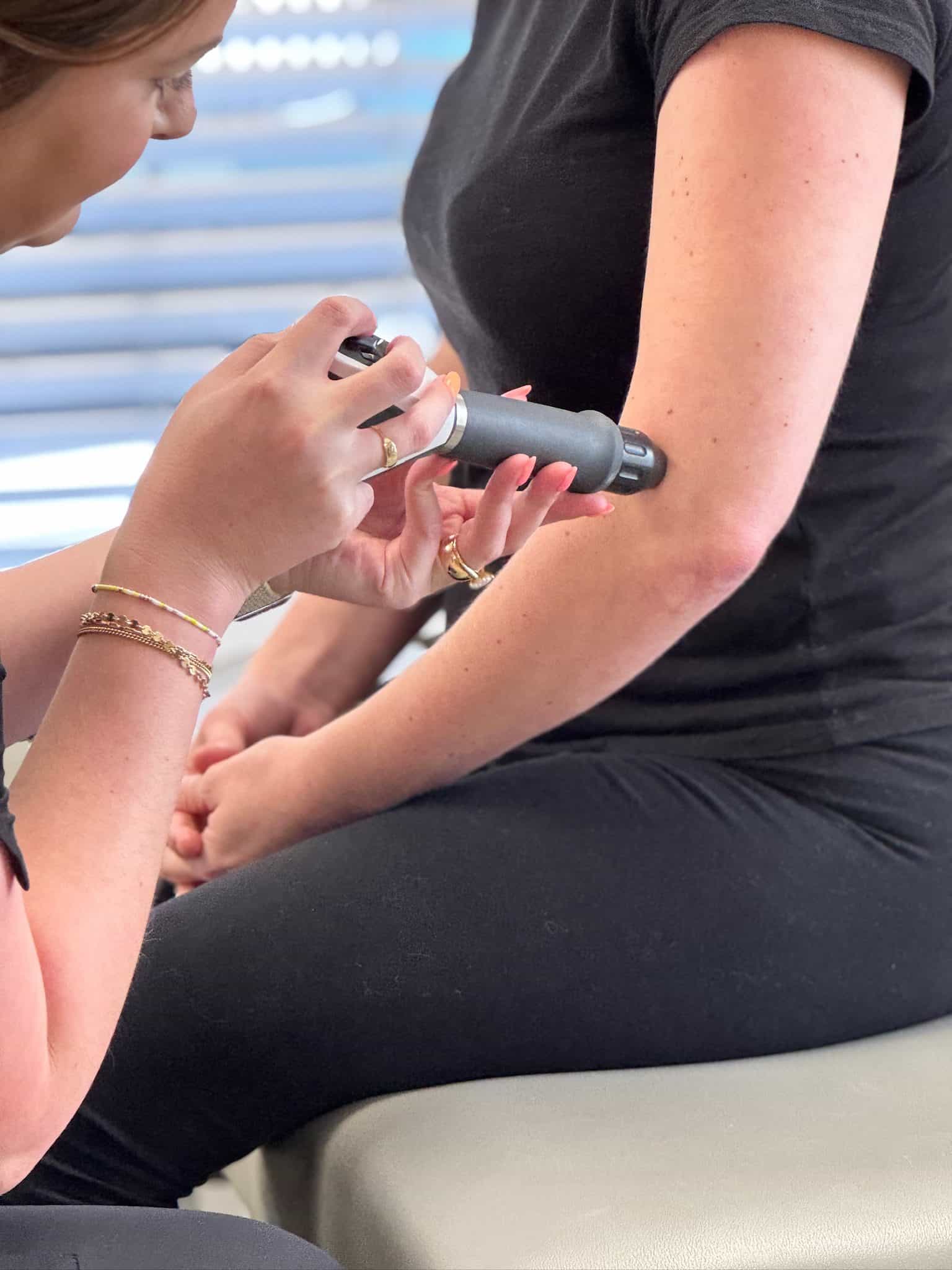
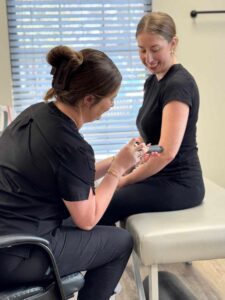
Once we’ve located the treatment zone, we apply a gel (similar to ultrasound gel) to help the shockwave handpiece transmit energy effectively. Then we deliver the acoustic waves in a systematic pattern across the affected tissue.
Most sessions take somewhere between 5 and 15 minutes of actual treatment time. The sensation is hard to describe – patients often say it feels like rapid tapping or a deep, pulsing pressure. It’s not exactly comfortable, but it’s tolerable for most people. We can adjust the intensity based on your feedback.
Here’s something patients appreciate: there’s no anesthesia involved, no incisions, and no recovery period. You walk out and go about your day. Some people feel a bit sore afterward, like they had a deep tissue massage. That typically fades within a day or two.
How Long Does Treatment Take?
Every patient’s protocol is different, and that’s intentional. Treatment duration depends on the condition, how long it’s been present, how your tissue responds, and what else we’re combining with shockwave. That’s exactly why we start with a thorough evaluation before recommending anything.
For chronic conditions that have been present for many months, the tissue remodeling process takes time. We’re asking your body to restart a healing process that had stalled. The clinical-grade equipment we use accelerates that process significantly compared to lower-powered devices – but the timeline is still something we determine together based on how you’re responding.
We reassess regularly throughout your care at our Indian Trail office. If you’re progressing well, we continue. If something needs to be adjusted, we adjust it. The evaluation determines the protocol – not a one-size-fits-all session count.
Why Combine Shockwave With Other Treatments?
Shockwave therapy rarely works best in isolation. At Indian Trail Chiropractic & Rehab, we almost always pair it with other interventions – because the acoustic waves address the tissue itself, but they don’t fix the movement patterns or biomechanical issues that contributed to the problem in the first place.
Consider plantar fasciitis again. Yes, the fascia is irritated. But why? Often there’s excessive pronation, tight calf muscles, or poor hip stability affecting how forces travel through the foot. If we only treat the fascia without addressing those factors, the problem is likely to return.
That’s where our corrective exercise programming and functional movement approach come in. We might also use Active Release Technique (ART) to address adhesions in the surrounding muscles, or look at your gait and consider whether custom orthotics would help distribute load more evenly.
Dr. Gentile’s background in sports performance means we’re always thinking about the whole kinetic chain – not just the spot that hurts.
Is Shockwave Therapy Painful?
This question comes up a lot. The honest answer: it’s uncomfortable, but most people tolerate it fine.
During the actual treatment, you’ll feel a rapid pulsing sensation. When we hit the most problematic tissue, it’s often more intense – some patients wince a bit. But that’s actually useful feedback. It tells us we’re targeting the right area.
After the session, mild soreness is normal. Think of it like the feeling after a workout or a firm massage. This usually resolves within 24 to 48 hours. We don’t recommend icing the area afterward, since some inflammation is actually part of the desired healing response.
What we tell patients: it’s not a spa treatment, but it’s far less intense than the chronic pain you’re trying to get rid of.
Who Shouldn’t Get Shockwave Therapy?
There are some situations where shockwave isn’t appropriate. We screen for these before recommending treatment.
If you’re pregnant, have a pacemaker, or are taking blood thinners, shockwave therapy isn’t recommended. We also avoid treating areas where there’s an active infection, open wound, or tumor. Bone that’s actively healing from a recent fracture is another contraindication – though interestingly, shockwave is sometimes used to promote bone healing in non-union fractures under the right circumstances.
For patients with peripheral neuropathy or significant circulation issues in the treatment area, we proceed cautiously and may recommend alternative approaches.
If you’re unsure whether you’re a candidate, that’s something we can discuss during an evaluation.
The Research Behind It
Shockwave therapy isn’t new, though it’s gained more attention in recent years. It was originally developed in the 1980s for breaking up kidney stones (lithotripsy). Researchers noticed that bone and soft tissue near the treatment area seemed to heal faster, which led to musculoskeletal applications.
The evidence base is strongest for plantar fasciitis and lateral epicondylitis. Multiple randomized controlled trials have shown benefit over placebo for these conditions. The research on other tendinopathies is growing and continues to support shockwave as a strong option – particularly for patients who haven’t responded to standard conservative care.
What we see clinically aligns well with the literature. Patients who’ve had symptoms for several months and tried conservative care without full resolution respond very well to shockwave. Shockwave produces its best outcomes when there’s actual degenerative tissue that needs stimulation, not just fresh inflammation.
What to Expect for Results
Shockwave therapy produces strong results for chronic soft tissue conditions. Most patients begin noticing meaningful improvement in pain and function as treatment progresses, with continued tissue remodeling happening in the weeks that follow.
In the early phase of treatment, some patients feel a temporary increase in soreness as the healing response kicks in. That’s the process working. As tissue repair progresses, pain decreases, function improves, and activities that were previously difficult become manageable again.
Full tissue remodeling continues for weeks after treatment ends – meaning results keep improving even after your protocol is complete. That’s one of the things that separates shockwave from treatments that only address symptoms short-term.
Results vary with every patient, which is why the evaluation matters. It lets us determine whether shockwave is the right tool for your specific presentation, and what a complete treatment approach looks like for you.
Frequently Asked Questions
How much does shockwave therapy cost? Pricing depends on your specific treatment plan, which we determine during your evaluation. Some insurance plans cover shockwave therapy – we’ll help you understand your options when you come in.
Can I exercise after a shockwave session? Light activity is usually fine. We recommend avoiding intense exercise that loads the treated area for 24-48 hours after each session. Your body needs that time to respond to the treatment.
How is this different from ultrasound therapy? Therapeutic ultrasound uses continuous sound waves at lower energy levels, primarily creating a warming effect in tissue. Shockwave therapy delivers higher-energy pulses that create mechanical stress and stimulate a significantly stronger healing response. They’re different tools for different situations – and the clinical-grade shockwave equipment we use is a step above what you’d typically find in a standard therapy setting.
Ready to find out if shockwave therapy is the right protocol for your condition? Schedule an appointment with Dr. Gentile at our Indian Trail office, or call (704) 821-3222.