

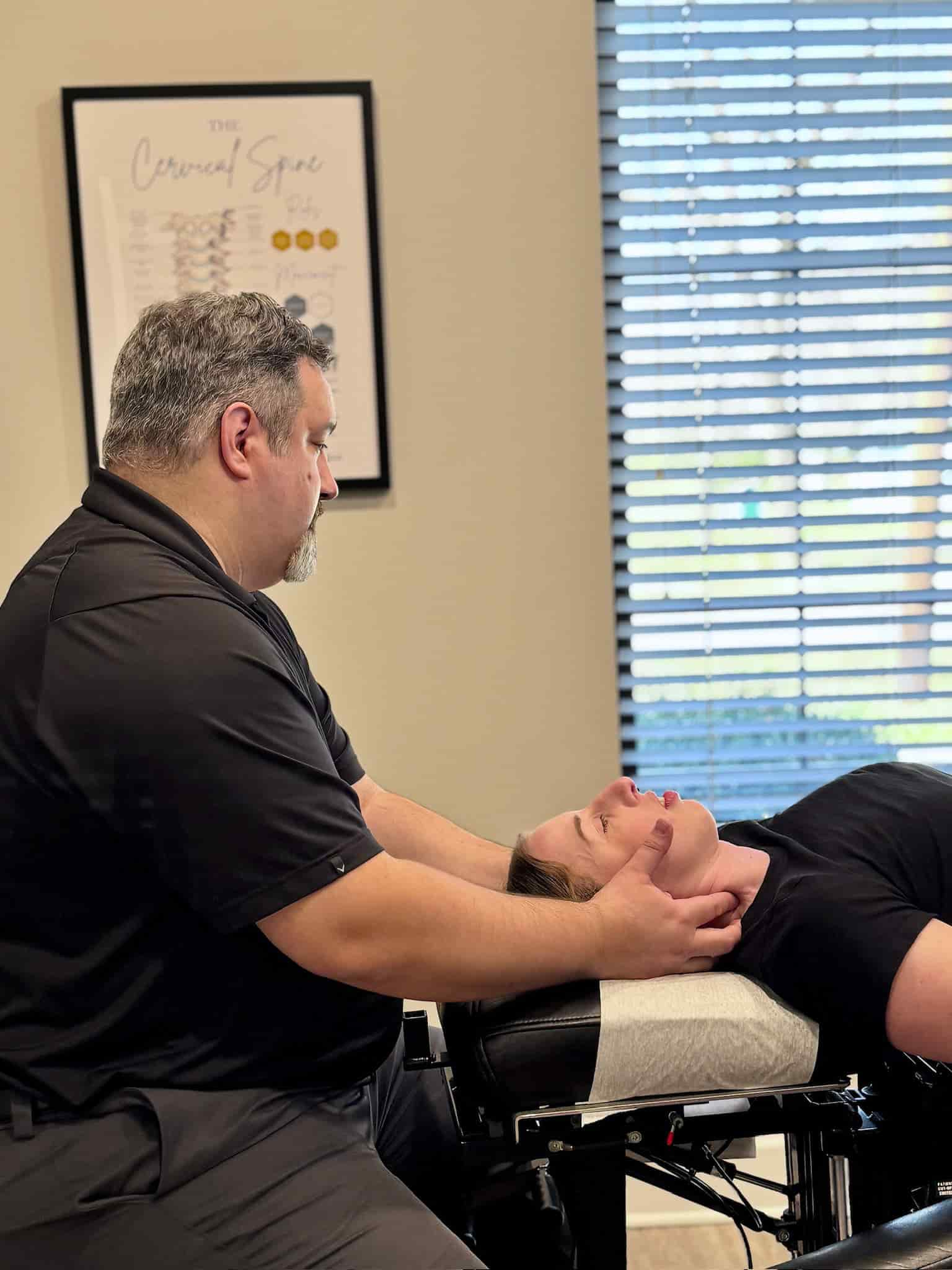
Poor movement patterns lead to chronic pain and injury because your body compensates for dysfunction until those compensations break down. When one area moves incorrectly, other areas overwork to make up for it, creating stress that eventually causes pain. At Indian Trail Chiropractic & Rehab, Dr. Gentile identifies faulty movement patterns and corrects them at the source, addressing the real reason your pain keeps returning.
Your Body Is a Chain, Not Separate Parts
Most people think about pain in isolation. Your knee hurts, so the problem must be your knee. Your back aches, so the issue is your back.
But your body doesn’t work that way. It functions as an integrated chain where each part affects the others. How your foot strikes the ground affects your knee. How your hip moves affects your lower back. How your mid-back rotates affects your shoulders and neck.
When one link in this chain moves poorly, the entire system compensates. Understanding this changes how you think about pain and, more importantly, how you fix it.
What Are Movement Patterns?
Movement patterns are the coordinated ways your muscles and joints work together to produce motion. Every time you walk, squat, reach, or bend, your body follows established patterns.
Ideally, these patterns distribute forces efficiently and load your joints and muscles appropriately. When patterns are dysfunctional, forces get concentrated in the wrong places, creating excessive stress.
These faulty patterns often develop so gradually that you don’t notice them until pain appears.
How Faulty Patterns Develop
Poor movement patterns come from several sources, often combining over time.
Prolonged Sitting
Hours of sitting shorten your hip flexors, weaken your glutes, and round your upper back. These adaptations change how you move even when you’re not sitting.
Previous Injuries
When you injure an area, you naturally move differently to protect it. These compensations often persist long after the injury heals, becoming ingrained patterns.
Repetitive Activities
Doing the same movements repeatedly, whether from work or sport, reinforces certain patterns while neglecting others. This creates imbalances over time.
Muscle Imbalances
When some muscles are tight and others are weak, your body compensates by recruiting the wrong muscles for various tasks. This faulty recruitment becomes your default pattern.
How Poor Patterns Create Pain
Understanding the mechanism helps explain why movement quality matters so much for pain.
Compensation Creates Overload
When one area can’t do its job properly, another area picks up the slack. That compensating area wasn’t designed for the extra work, so it becomes overloaded and eventually painful.
For example, if your glutes are weak, your lower back and hamstrings compensate during movement. Over time, this overload creates back pain or hamstring problems.
Joints Get Stressed Abnormally
Faulty patterns place stress on joints in ways they aren’t built to handle. This abnormal loading accelerates wear and creates pain.
The Pain Location Isn’t the Problem
Here’s the key insight. The place that hurts is often the victim, not the culprit. Your painful knee might be suffering because of poor hip control. Your aching back might be compensating for stiff hips.
Treating only where it hurts misses the actual cause, which is why the pain keeps returning.
Common Dysfunctional Patterns We See
Certain faulty patterns show up repeatedly and predict specific pain problems.
Weak Glutes and Lower Back Pain
When your glutes don’t fire properly, your lower back and hamstrings overwork during activities like lifting, walking, and standing from a seated position. This is one of the most common contributors to chronic back pain.
Poor Hip Mobility and Knee Pain
Stiff hips force your knees to compensate during movement. The knee ends up absorbing stress it wasn’t designed for, creating knee pain.
Limited Ankle Mobility and Chain Dysfunction
Restricted ankle motion creates a chain reaction. Your knees collapse inward, your hips rotate, and your lower back compensates. A single ankle restriction can cause problems all the way up the body.
Poor Thoracic Mobility and Neck Pain
When your mid-back is stiff, your neck and shoulders compensate for the lost rotation and extension. This contributes to neck pain and shoulder problems.
How We Identify Faulty Patterns
You can’t fix what you can’t see. That’s why proper assessment is the foundation of correcting movement patterns.
Movement Screening
Our Kinetisense 3D movement screening objectively measures how you move, revealing dysfunctions and asymmetries that aren’t visible to the naked eye.
Functional Assessment
I watch how you perform fundamental movements like squatting, bending, and reaching. These reveal compensation patterns and identify which areas aren’t functioning properly.
Identifying the Root Cause
By assessing your entire kinetic chain, I find the actual source of your dysfunction, not just where you feel pain. This guides treatment to the real problem.
How We Correct Movement Patterns
Fixing faulty patterns requires a comprehensive approach that addresses all the factors involved.
Restoring Joint Mobility
Restricted joints prevent proper movement. Chiropractic adjustments restore mobility so your body can move correctly.
Releasing Tight Muscles
Tight muscles limit proper movement and reinforce faulty patterns. Active Release Technique releases these restrictions.
Activating Weak Muscles
Muscles that aren’t firing properly need to be reactivated and strengthened. This retrains your body to use the right muscles for each task.
Retraining Movement
Our Functional Movement Program retrains proper movement patterns so the corrections become automatic. This is what creates lasting change.
Why This Approach Prevents Recurrence
Treating symptoms provides temporary relief. Correcting movement patterns addresses why the symptoms developed in the first place.
When you fix the faulty pattern causing your pain, the pain doesn’t just improve temporarily. It resolves because the underlying dysfunction is gone. This is the difference between managing pain and actually fixing the problem.
Better Movement Beyond Pain Relief
Correcting movement patterns does more than eliminate pain. It improves how you move in everything you do.
Athletes perform better with efficient movement. Everyday activities become easier. Your risk of future injury drops significantly. You move with less effort and more freedom.
Why Choose Indian Trail Chiropractic
Correcting movement patterns requires understanding how the body functions as an integrated system. My background in biomechanics and sports performance gives me unique insight into identifying and fixing faulty patterns.
We don’t just chase your symptoms. We find the movement dysfunction causing your pain and correct it at the source. This comprehensive approach delivers lasting results.
With over 20 years of experience, we help patients throughout Union County move better and eliminate the pain that faulty patterns create.
Move Better and Eliminate Pain
If chronic pain or recurring injuries are frustrating you, faulty movement patterns are likely the underlying cause. At Indian Trail Chiropractic & Rehab, we identify and correct these patterns so you can move well and stay pain-free.
Ready to fix the root cause? Call us at (704) 821-3222 or schedule your appointment online today.